
The Jungle

“The death of one man is a tragedy. The death of millions is a statistic.” Joseph Stalin.

Recently, a 19-year-old boy from Ghana committed suicide, having arrived at Calais as a refugee. Sadly, he is one of hundreds, who have taken their own life whilst seeking help from Europe. Who is to blame for the deaths of so many people? Helprefugees.org have stated the death toll stands at around 35,000. 27,000 drowned. 600 murdered. 500 suicides. Many of these suicides are children, but all of them people. A third of children evicted from “The Jungle” vanished. It’s unbearable to think about what happened to them. The Guardian recently wrote of the children forced to prostitute themselves to secure travel over the border, while Save the Children confirmed children are getting food and shelter in return for sex. Why are we putting borders before people? “These very young, and particularly at-risk girls, who are among the invisible flow of unaccompanied migrant minors….in an attempt to reunite with their relatives…” (The Guardian). The charity stated that more than “1,900 girls had been sexually exploited…between January 2017 and March 2018…” Who is responsible for the deaths and sexual exploitation of these people?

On 26th April 2016 the UK Parliament voted 294 to 276 to reject 3,000 Syrian child refugees who had travelled to Europe. Conservative MP’s voted to prevent children being given a haven; yet offering safety to just minors should have been the bare minimum. The world will look back on that day and say, “never again”. As we all have, time and time again. When people say “if I was there I would have…” The reality is, what you are doing now, what you are saying now, is what you would have done in 1942 Nazi Germany, or in Stalinist Russia, or during the slave trade, or apartheid. Our time is now; to make a difference to how people are treated. To show compassion to those who ask for our help. Human beings have carried out millennia of mass murder, genocide and torture against their own species; while those unaffected turn a blind eye. Like a child who covers their face and thinks no one can see them.

Why do so many treat refugees like this? What makes them less important to our governments? Is it that Parliament is a mirror of the people; they vote against kindness, because that’s what the public would want? Is it the right-wing press propagating a hateful version of our society to back moderate Tories into a corner? As individuals we can make a difference, by the way we vote at General Elections. It is our responsibility to cast our vote in the ballot box to represent the ideals we want for our society.

When that photo of the tiny child (Omran), sitting in an ambulance, bleeding and covered in dirt was published or the picture of Alan Kurdi’s body being recovered from the water, the world wept for the horror and pain. It’s a struggle to believe that so many people do not care. It is possibly the inability to understand such fear and pain, and so we switch off, letting the fascist right-wing press shout their hate speech. To be human, is to have humanity. Sometimes it takes a picture of a dead boy on a beach, or the suicide of a 19-year-old, to remind us we are all one people.

Why do we let people suffer because their nationality is not the same as ours? Just because a group of people are from the same country, does not mean they are any more similar than someone from thousands of miles away. We are all different, and yet, we are the same. Is it time to view borders in a different way to the past?

What makes a person travel so far, over land and sea, through hell, and at the end of it all takes their own life? Is it to get benefits? Bear in mind that 35,000 people have died, 27,000 crossing oceans. The media often use incorrect terms to describe refugees. They use the word “migrant” interchangeably. Refugee describes people who cannot return to their home country, because they face persecution, torture, imprisonment and death. Migrants chose to travel for work, money or to live with relatives. This is an important distinction to understand why someone risks their life and the lives of their children. The people who have taken that fatal trip have travelled to survive.

The Tories often boil it down to budgets and money; “money doesn’t grow on trees”. Well nor do people. People must come before money. Further, it’s not that black and white. Money for a wealthy western country is not as hard to find as the Conservatives would have you believe. When will Western governments realise that when we treat people with kindness, invest in them and their futures, great things can happen. It is short sighted to see refugees as a burden. People who have survived an unimaginable hell, that most cannot possibly fathom, have qualities/abilities that bring innovation and development.

The 19-year-old boy who killed himself, did it in Calais. Having lived in Ghana, through violent conflict, having travelled thousands of miles to try and find safety; a reprieve from hell. Remember, he did not kill himself when he still lived in destruction, but in a refugee reception centre in Calais. Throughout the horrific journey, throughout the abuse, the psychological effects, the pain of looking for salvation, he persevered. The hell he would have endured is nothing that you and I can relate to. His hopeful quest for a new life in Europe came to an end in Calais, so close to the borders of Britain. He lost hope. In his despair, he took his own life. Because no one in the world would help him, no one offered him safety. Do not think of this young man as a refugee statistic, but a person. A person, like you and I, who has hopes and dreams, who smiles and cries, who went to school, who had a family.

natalya-letunova-275086-unsplash


Soubry’s Sovereignty


“Sovereignty” described as the “supreme power authority…the authority of a state to govern itself or another state…” (Oxford English Dictionary). The sovereignty of Parliament is proven; otherwise the notion of Brexit would not exist. When the British Empire ruled over vast lands, those countries did not reinstate their own sovereign power. After rebellions, bloodshed and treaties, the countries of the British Empire were eventually granted their freedom. The intrinsic element of “sovereignty” is that Parliament can make or unmake any law and decide how the country should be governed. At first glance, the use of “sovereignty” seems appropriate; “Bureaucrats in Brussels” telling Westminster what to do. It seems straightforward and utterly unseemly; for us British, never having been ruled by any country for almost a thousand years, to be ruled by the EU. Yet, as with all far-right explanations of complicated topics; the meanings are boiled down into simple black and white catch-phrases, which are far from accurate.

Anna Soubry’s recent impassioned speech in Parliament revisited the term “sovereignty” used so freely by Leave on the lead up to, during and after the 2016 result. Her words were cutting to leading Tory MP’s, and rightly so; the consequences of a hard Brexit are unthinkable. Particularly for those of us who rely on our salaries. Soubry stated that “nobody voted leave on the basis that somebody with a gold-plated pension and inherited wealth will take their job away from them”. Soubry continued to point out the loss of “hundreds of thousands of jobs…” is the price for MP’s regaining their sovereignty. This is somewhat contrary to the responsibility MP’s and Parliament have for the people of Britain. So why are our jobs being risked for a term used mostly by lawyers, politicians and academics? Did we lose our sovereignty when we joined the European Union, or did we agree to the rules of an economic community and trade group?

Imagine, a normal street with 28 houses. For years the houses of The Street have been at war; causing destruction to the land, bankruptcy and death. Almost whole generations wiped out, whilst economic collapse, political extremism and hateful propaganda raged for decades. Then one day members of some of the leading houses came together to discuss terms of peace. To secure these peace terms, the houses created mutual economic interests through trade. These agreements created rights for the individuals of their houses, both at work and in their private lives. It was the beginning of a new time; of peace.

Prosperity grew through the decades; The Street had become a superpower within the community. To achieve this, every house had to agree to follow the same rules. This harmonisation allowed trade to happen as seamlessly as possible, and individuals could enter other houses without barrier, to carry out their duties. Goods could travel freely without tariffs, which reduced the price of goods made and sold on The Street. The workers received the same protections, regardless of which house they lived in. However, the greatest accomplishment of The Street was the peace experienced for the longest period in their history.

The Street would not have worked had everyone written their own laws. An agreement requires all parties follow the same rules to create consistency and efficient processes. The agreement was written by the houses’ leaders, who continue to vote on amendments and new laws.


Britain did not give up sovereignty to an outside power. The European Union created a trade agreement, which all 28-member states agreed to. So, why has Britain gone on this quest to regain sovereignty? Perhaps it is the “red tape” Leave talk so strongly about; to unburden businesses? Regulations, also known as “red tape” are workers’ rights. 28 days paid holiday, maternity pay, maximum working hours and entitlement to breaks to name a few. Many of these rights, such as 28 days paid holiday are not automatic rights in many advanced countries outside the EU. Whilst some of the regulations need to be amended or repealed, many include our rights.

The quest for sovereignty is not about the people “taking back control” of “our country” but about reducing our workers’ rights to speed up the capitalisation of business. The European Communities Act 1972 created constitutionally protected rights through joining the European Union. Essentially, Brexit will pass control to a Conservative government who, for example, voted against the Labour Bill to make private lettings fit for human habitation over a year ago. This was voted on just after the Grenfell Tower tragedy; an example of the law protecting businesses and not people.

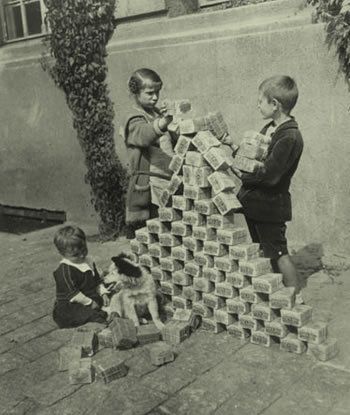
Should Soubry be correct that “hundreds of thousands of jobs will be lost” (knowingly by members of the Cabinet), then where will we stand when demand for jobs becomes even greater? Hundreds, maybe thousands may go for the same job, which means companies will have their pick. There will be less negotiation of contract terms because the need for a job will become so great. Should Parliament create new laws to reduce Worker’s rights, people will have no choice but to accept weak statutory contracts. Will the pound become worthless? Will the NHS still exist? What does a country look like after economic collapse? Look no further than Germany in the 1920’s.


Are we swapping our jobs, homes and futures for a political quest, to give more power to a government who would take away our rights?


Children playing with money, in Germany because it was worthless:

2ce449afaf3c16f8d226f71eade6e7b2--worthless-kids-playing

Snowflakes or Snowstorms?

“Snowflake”, the term coined by the far right to undermine the opinions of those who oppose them. Described by Cambridge Dictionary as “a way of referring to the type of young people to be too easily upset and offended”. Originating from the 1996 film “Fight Club”; a way of insulting liberals. The fragility of the snowflake, in its individuality makes it a seemingly ideal euphemism for humanitarian, leftie-liberals, who believe in the rule of law to protect a person from the extremities of the far-right. The term is used as both a form of prejudice and an attempt to undermine the opinions of those who disagree with them. It is perhaps synonymous with far-right tone in general; the boiling down of complex areas of law, society, trade and economic debate into simple catch-phrases like “taking back control”. However, what if a snowflake is more than a fragile piece of ice, that melts on the warmth of the skin?

The importance of this term is not in the fragility of the individual, but the power as a group. The derogatory impact on those who believe in the power of equality and truth, is insignificant. The snowflake is an individual product of a freezing harsh winter, of snow and ice. Alone it is just a snowflake, but thousands or even millions is a snowstorm. To use George R.R. Martin’s famous Stark phrase “winter is coming”. Of course, not the army of the dead, but those who oppose far right political agenda and what it leads to.

Is “snowflake” derogatory, or is it an element of something much bigger; more powerful, stronger than a single, falling snowflake? It represents uniqueness, kindness, and empathy. Together, a snowstorm through the power of our voice, our humanity and ability to understand. To look upon refugees entering a port on a boat, with the same eyes we do a neighbour who asks for help. It is not weakness to show kindness, but strength.

“Too easily upset and offended” is a correct definition of the term the far-right coined “snowflake”, but in context it is oversimplifying empathetic people. In the dystopian age of Trump, and the detached age of Brexit; too easily upset and offended is incorrect. Watching the persecution of immigrants crossing borders, living in a time where children are snatched from their parents and caged is not “too easily upset”. Trump’s “Muslim ban” is not an example of being “too easily…offended”. Farage, inaccurately blaming the EU in the “Breaking Point” poster, is not “too easily upset and offended”. These are people; mothers, brothers, sisters, doctors, teachers, and lawyers. These examples are typical fascist and far-right political agenda; to create fear and hate. The consequences of this rhetoric throughout history has resulted in oppression, war and genocide. And we are “too easily upset and offended”? Imagine it was your child taken and caged, would you not be offended? Imagine it was your child screaming for help, alone, scared, would you not be upset? Do the terms upset and offended still apply?

We are a snowstorm, and we are showing no signs of abating.


cropped-snowfall-201496_1280.jpg